Unleash the Legend in a New Ford Mustang in Eau Claire, WI


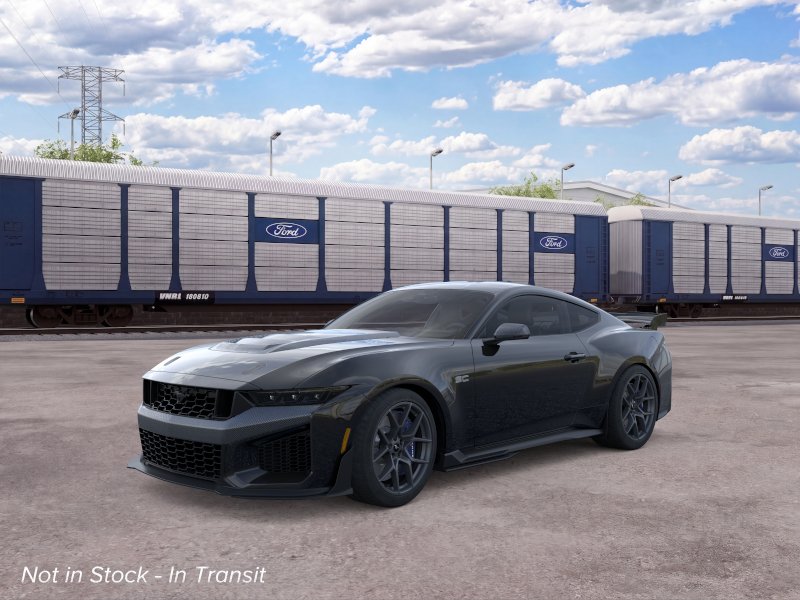

Frequently Asked Questions about the New Ford Mustang Eau Claire, WI
What engine options are available on the new Ford Mustang?
The Mustang is available with two distinct engine choices: a 2.3L EcoBoost turbocharged four-cylinder and a 5.0L Coyote V8 producing 486 horsepower with the naturally aspirated character and high-rpm delivery that defines what most people picture when they think of a Mustang. The EcoBoost delivers strong turbocharged torque with better daily fuel economy and a lower entry price that creates room for options and packages, making it a genuine choice on its own terms rather than a compromise. The Dark Horse performance model uses a specially tuned version of the 5.0L V8 producing 500 horsepower with unique engine internals and comes standard with a Tremec 6-speed manual transmission.
What is the Ford Mustang Dark Horse?
The Dark Horse is the performance flagship of the current Mustang lineup — a track-focused model built around a specially tuned 5.0L V8 producing 500 horsepower with internal components not shared with the standard GT engine. It comes standard with a Tremec 6-speed manual transmission, available MagneRide adaptive suspension, Brembo six-piston front brake calipers, and chassis calibration that prioritizes precision and responsiveness over ride compliance. The Dark Horse is the Mustang for buyers whose primary requirement is track and high-performance road capability — it's not the right configuration for buyers whose main use is daily commuting comfort.
Is the Ford Mustang available as a convertible?
Yes — the Mustang is available in both fastback coupe and convertible body styles across most powertrain and trim configurations. The convertible uses a power-operated soft top that opens and closes at low speeds, making it practical for opportunistic use on warm days rather than requiring pre-trip planning or a dedicated parking setup. Wisconsin's shoulder seasons — late spring through early fall — produce exactly the kind of open-road conditions the convertible was built around, and buyers whose routes include roads worth experiencing tend to find the body style premium well justified over the course of an ownership period.
Is the Ford Mustang practical enough to use as a daily driver?
The EcoBoost Mustang in particular functions well as a daily driver — fuel economy in normal driving is meaningfully better than the V8, the cabin features a 13.2-inch touchscreen, full digital instrument cluster, and wireless device connectivity on par with modern crossovers, and Ford Co-Pilot360 provides the active safety suite most buyers expect daily. The trade-offs relative to a sedan or crossover are real: trunk space is smaller, rear seat access and legroom is modest for regular adult use, and the performance tire and sport-calibrated suspension combination registers road surface with a firmness that buyers should experience before committing. Wisconsin buyers planning year-round use should also plan for a dedicated winter tire set rather than running performance tires through the coldest months.
What performance technology is available on the Ford Mustang?
Available performance technology includes MagneRide adaptive dampers that continuously adjust suspension response based on road surface and driver inputs, Track Apps for monitoring 0-60 runs, quarter-mile times, g-force, and braking distances through the digital instrument cluster, and Launch Control for consistent, repeatable hard acceleration starts. Line Lock holds the front brakes during track prep burnouts, and the Active Valve Performance Exhaust on V8 models adjusts exhaust volume between Quiet, Normal, Sport, and Track modes — practically useful in a residential neighborhood at 7 a.m. and fully satisfying on an open road when the circumstances allow it. Brembo brake packages available on GT and Dark Horse models bring six-piston front calipers for improved pedal feel and fade resistance under repeated hard stops.
Have Additional Questions?
Not sure whether the EcoBoost or V8 fits your priorities, or whether the fastback or convertible matches how you plan to use it? Reach out to Eau Claire Ford and we'll give you a straight answer based on your actual situation rather than steering you toward the more expensive option.
Questions about what the Dark Horse adds over the GT, how MagneRide and Track Apps work in real driving conditions, or which performance packages make sense for your use case? Our team knows the Mustang lineup specifically enough to answer detailed questions rather than general ones.
Mustang stock moves — particularly in specific colors and package combinations. Reach out before your visit to confirm what's currently on the lot so you arrive with an accurate picture rather than discovering your preferred configuration is already gone.
Six Decades of American Performance — What the Mustang Nameplate Actually Carries
The Mustang has been in continuous production since 1964 — longer than most buyers have been alive, and long enough that the nameplate carries a weight no spec sheet captures. Buying one connects you to something larger than the specific vehicle sitting on the lot: a car that defined an entire category of automobile, survived every economic cycle and automotive trend across six decades, and remains one of the few vehicles that generates a genuine response from people who see it on the road. That's not a marketing outcome — it's the result of a car that consistently delivered on what it promised to drivers who cared how a vehicle feels, across every generation of the nameplate.
The current generation carries that history forward without treating it as a constraint. The 13.2-inch curved touchscreen and full digital instrument cluster are as current as anything on sale today; the 5.0L Coyote V8 and available Tremec 6-speed manual transmission connect to the mechanical philosophy that made the Mustang worth caring about in the first place. It manages the rare combination of being a genuinely modern car that doesn't apologize for what it came from.
- Fastback coupe and convertible body styles available — two ways to experience the same platform and powertrain lineup
- 5.0L Coyote V8 and 2.3L EcoBoost four-cylinder — two distinct powertrain philosophies for two different kinds of Mustang buyer
- Strong resale values, an extensive owner community, and a deep parts and support ecosystem built across six decades of production
The Mustang's cultural reach translates into practical ownership advantages that newer performance vehicles haven't had time to build. Resale values hold with more consistency than most sports cars, the owner community is knowledgeable and active, and the support infrastructure — parts availability, specialist expertise, aftermarket depth — reflects decades of continuous production rather than a model that's still establishing its footing.
For buyers who've been drawn to the Mustang at some point in their lives, Eau Claire Ford is the right place to work through what that means in the context of the current lineup — which trim, which powertrain, and which configuration actually matches the version of the car you've been thinking about.
EcoBoost or V8: A Decision That Goes Deeper Than the Horsepower Number
The choice between the Mustang's 2.3L EcoBoost four-cylinder and the 5.0L Coyote V8 is genuinely different from most powertrain decisions in the automotive market. Both engines make the Mustang fast in objective terms — the EcoBoost produces strong turbocharged torque across a wide rpm range, and the V8 delivers 486 horsepower with the kind of linear, all-rpm pull that naturally aspirated engines produce and turbocharged ones replicate differently. The decision isn't about which one is adequate for the task; it's about which one fits your specific relationship with how a performance car should feel and what it should sound like.
The EcoBoost case is stronger than the "entry engine" framing implies. Better fuel economy in normal driving, a lower starting price that creates room in the budget for performance packages and options, and turbocharged mid-range torque that's immediately accessible without revving toward the top of the tachometer make the EcoBoost a legitimate choice rather than a concession. On a technical road course or a winding back road with mixed corner types, the EcoBoost's torque delivery and lighter front-end weight produce a balanced chassis experience that suits certain driving styles better than the V8's character does.
- EcoBoost 2.3L: turbocharged four-cylinder with accessible mid-range torque, better daily fuel economy, and a lower entry price that creates option budget
- 5.0L Coyote V8: 486 horsepower, naturally aspirated high-rpm delivery, and an exhaust note that defines what most people mean when they picture a Mustang
- Dark Horse: specially tuned 5.0L at 500 hp with unique internals, Tremec 6-speed manual standard, and Brembo six-piston front brakes — the performance flagship
The V8 makes its most compelling argument in two specific places: the sound and the behavior above 6,000 rpm. The Coyote V8's naturally aspirated exhaust note — particularly with the Active Valve Performance Exhaust fully open — is the sound most people carry in their heads when they imagine a Mustang. And in the top third of the rev range, the V8 delivers an experience that the EcoBoost, for all its competence, doesn't replicate. Whether those two qualities justify the fuel economy and price difference over the EcoBoost is the real decision most buyers face when they're sitting between the two configurations.
A back-to-back test drive is the most useful investment of time you can make before committing to either powertrain. The character difference is immediate and concrete in a way that comparing specifications doesn't convey, and most buyers have a clear answer within the first few miles of each. Our team at Eau Claire Ford can arrange that comparison during your visit.
Fastback or Convertible: Two Ways to Experience the Same Icon
The fastback coupe and the convertible share the same platform, the same powertrain options across most configurations, and the same fundamental Mustang character — but the experience of driving them is distinct enough that the body style decision deserves deliberate thought rather than a default toward whichever one costs less. The fastback's fixed roofline produces tighter overall body rigidity, a more aggressive and purposeful silhouette, and a slightly more connected feel on roads where the chassis is being worked hard. For buyers who prioritize driving dynamics, structural integrity, and the fastback's proportions as the defining visual expression of what a Mustang looks like, the coupe is the clear choice.
The convertible's power-operated soft top changes what driving means in a way that's difficult to communicate on a spec sheet. The engine sounds different with the top down. Acceleration feels different. Roads that are pleasant in a closed car become genuinely memorable in an open one — and Wisconsin's shoulder seasons, from late April through October, produce exactly the conditions the convertible was designed to be experienced in. Cool mornings, warm afternoons, fall foliage runs on county roads north of Eau Claire: the soft top opens at low speeds on demand, making open-air driving an opportunistic decision rather than one that requires a planned effort.
- Fastback: tighter body rigidity, more aggressive roofline, and a dynamics advantage on roads where chassis stiffness produces a more connected feel
- Convertible: power soft top opens and closes at low speeds — open-air driving available on demand rather than requiring pre-trip planning
- Both body styles available across most trim and powertrain combinations — the body style decision doesn't constrain your other configuration choices
The convertible premium is worth evaluating against what it actually delivers over an ownership period rather than as an upfront cost in isolation. A buyer who opens the top thirty weekends a year accumulates an open-air driving experience across an ownership period that changes the calculation considerably from the perspective of the purchase moment. For buyers whose regular routes include roads worth experiencing — and the area around Eau Claire has them — the convertible tends to reward the premium consistently across the seasons when it can be used.
Driving both body styles back to back is the fastest route to clarity on which one fits. The fastback and convertible feel different in ways that reveal a preference quickly — and the choice that emerges from that experience tends to hold up over years of ownership better than a decision made on spec comparisons alone.
Performance Technology That Produces Real Differences in Real Conditions
The Mustang's available performance technology is worth understanding as systems that produce measurable results in specific conditions rather than features that look impressive on a window sticker. Available MagneRide adaptive dampers continuously adjust suspension response based on road surface inputs and driver behavior — stiffening for cornering support and high-speed stability, softening for compliance over imperfect surfaces, cycling through adjustments within milliseconds as conditions change. The difference between a Mustang with MagneRide and one without becomes most apparent on back roads where the surface varies and the suspension is asked to handle both performance cornering and pavement imperfections in rapid sequence.
Track Apps is the Mustang's onboard performance data system, accessed through the digital instrument cluster — it records and displays 0-60 mph runs, quarter-mile times and trap speeds, reaction times, g-force figures, and braking distances. Launch Control manages wheel spin and power delivery during hard starts for consistent, repeatable acceleration runs rather than leaving the outcome to throttle feel and timing. Line Lock holds the front brakes while allowing the rear wheels to spin freely during track prep burnouts. These are systems that the Mustang's actual performance-driving owners have requested and validated across multiple model generations, not marketing additions invented to fill a features list.
- Available MagneRide adaptive suspension — continuously adjusts damping response for both performance cornering and surface compliance in real time
- Track Apps — records 0-60, quarter-mile, g-force, and braking distance data through the digital instrument cluster during performance driving
- Active Valve Performance Exhaust on V8 models — adjusts exhaust volume and character between Quiet, Normal, Sport, and Track modes based on driving context
The Active Valve Performance Exhaust available on V8-equipped Mustangs deserves specific attention for daily driving practicality. Quiet mode produces a significantly subdued exhaust note suitable for early morning departures in a residential neighborhood or situations where the full V8 sound would be inappropriate — the same system that opens fully in Sport or Track mode on an open road. It's a rare performance feature that addresses both the real-life constraint of living with a performance car in normal environments and the desire for the complete exhaust character the engine is capable of producing when conditions allow.
The available Brembo brake packages on GT and Dark Horse models — six-piston front calipers over large rotors — deliver improved pedal feel and fade resistance under the kind of repeated hard braking that track use and aggressive back-road driving produce. Performance buyers who've experienced brake fade on other vehicles understand the value; buyers who haven't tend to learn it the first time they encounter a situation that demands repeated full stops in quick succession.
Driving a Mustang Every Day Near Eau Claire, WI — What That Actually Looks Like
The question of whether the Mustang works as a daily driver deserves an honest answer rather than an enthusiast's deflection. The trade-offs are real and worth knowing before purchase: trunk space is functional but smaller than a sedan or crossover, and loading it requires some deliberateness rather than throwing things in. Rear seat access involves a step and a duck that full-size adults manage but don't enjoy as a regular routine. The sport-calibrated suspension and performance tire combination registers road surface with a fidelity that some drivers describe as engaging and others describe as tiring over a long commute on Wisconsin's rougher sections of pavement. These are the facts of the car.
What the Mustang provides on the other side of those trade-offs is a commute that feels different — and for the buyer whose daily route includes any stretch of road that rewards a car that responds to it, that difference has value that compounds daily. The current generation's 13.2-inch touchscreen, full digital instrument cluster, wireless Apple CarPlay and Android Auto connectivity, available heated and cooled front seats, and Ford Co-Pilot360 safety suite bring the feature content up to the standard any modern daily driver should meet. The EcoBoost trim's fuel economy in normal driving closes the gap with a crossover considerably, making the operating cost of daily Mustang use more realistic than the V8's consumption profile allows.
- 13.2-inch touchscreen, full digital instrument cluster, and wireless device connectivity — daily-driver technology in a performance car package
- Ford Co-Pilot360 safety suite with available adaptive cruise control — active driver assistance for the commute as well as the back road
- EcoBoost fuel economy makes daily driving financially sensible — the V8's consumption profile is better suited to buyers who accept the fuel cost as part of the ownership experience
Wisconsin's winters introduce a practical consideration that's worth addressing directly. The Mustang is rear-wheel drive, and performance summer or all-season tires are not winter tires — they don't perform adequately on packed snow and ice regardless of driver skill. Buyers who plan to drive the Mustang year-round in the Eau Claire area should budget for a dedicated set of winter tires on steel wheels, which transforms the cold-weather ownership experience from anxious to manageable. Buyers who plan to garage the car or switch to a second vehicle during the deepest winter months will find the RWD an irrelevant consideration for the ten months the car is actively enjoyable on Wisconsin roads.
The buyers who find Mustang ownership most satisfying over time are those who went in with clear eyes about what the car delivers and what it asks for in return — and concluded that the exchange was worth making. Eau Claire Ford's team can help you have that honest conversation rather than the version where every trade-off gets minimized until it shows up in daily life.
Browse Eau Claire Ford's current Mustang inventory online to see what's in stock across trim levels, powertrain choices, and body styles right now, get an instant estimate on what your current vehicle is worth as a trade, or reach out to our team in Eau Claire, WI — we'll help you find the Mustang configuration that matches the car you've been thinking about and the way you actually plan to drive it.